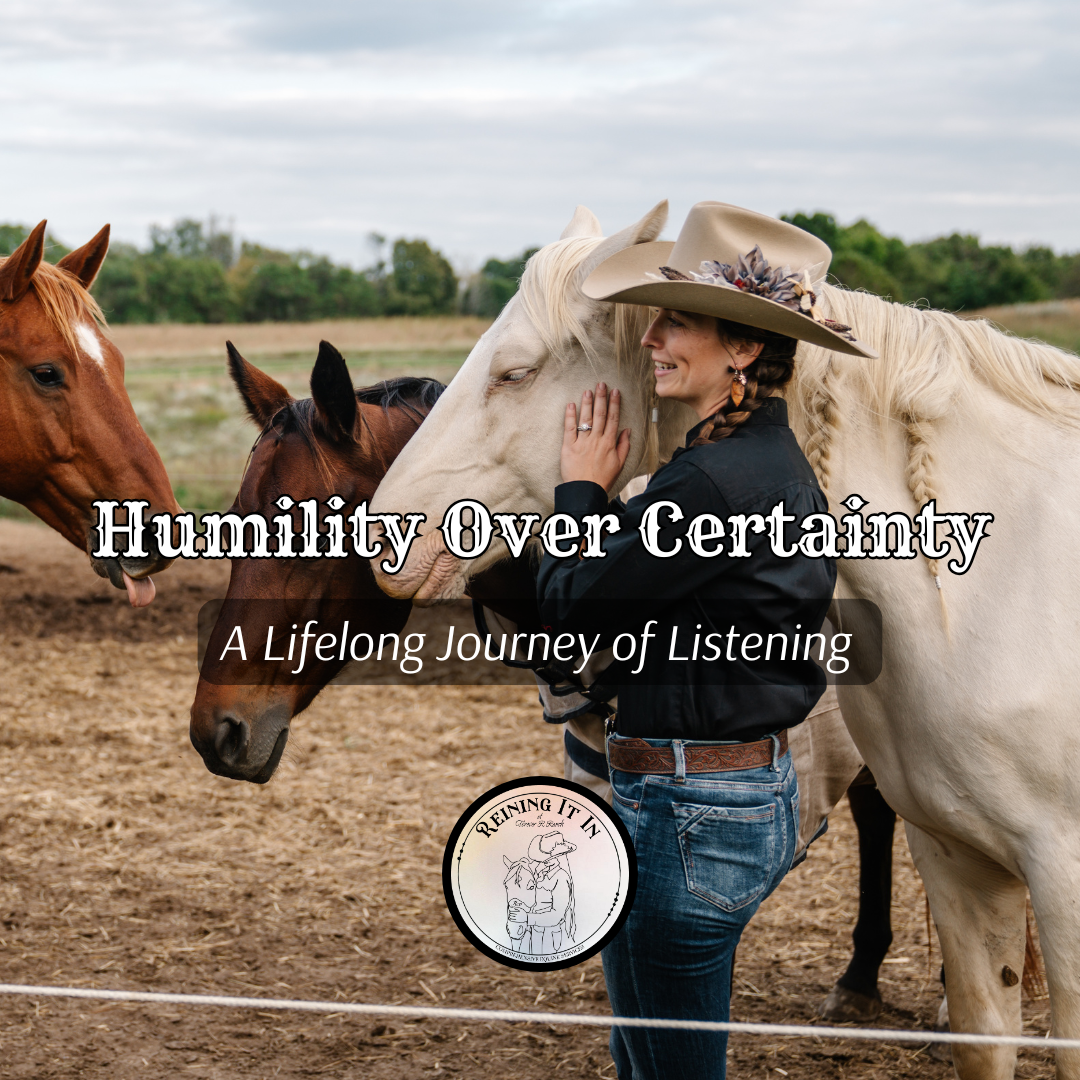
Humility Over Certainty

Were You Taught…
Were you taught by mentors you trusted to rely on your own understanding of animals you didn’t design?
I was.
I learned from horse people who worked hard. People who wanted to do things “right.” I took mentorship from the experienced rather than looking deeper for insight from the One who created not only the horse, but our entire existence.
I learned that knowledge meant more than humility.
I learned “Go educate yourself,” to display confidence, certainty, and answers.
And for a long time, I chose that path.
Because modesty meant surrendering my certainty.
The passive-aggressive comment, “Go educate yourself,” won’t get us anywhere.
Discernment, trust, and surrender to reality will.
The desire to learn about what we love is planted within us early. As children, we naturally hyper-focus on what captivates our hearts. For me, it was drawing horses, playing with toy horses, reading about horses, and riding whenever I could. Everyone knew—my life would involve horses.
When interest begins, a community forms around it. Mentors appear. Examples of care, handling, and riding surround us. Articles, videos, clinics, and opinions are always within reach.
Learning validates our passion. It moves us closer to our dreams.
But in this age of limitless information, discernment becomes work. We search for voices that align with our values so we aren’t overwhelmed. We look to those who have achieved what we hope to achieve.
Yet every person carries a unique mix of experiences, facts, and assumptions. Many become confident in their own conclusions. Some aim to be the Next Big Thing by leaning heavily on personal interpretation.
And slowly, we forget:
We are limited.
We cannot see everything.
We cannot know everything.
We cannot sift it all.
Why We Trust Our Own Understanding
Our understanding is shaped by our surroundings.
Tradition.
Schooling.
Work.
Life events.
We observe what others do and seek comfort in belonging. We form beliefs based on acceptance.
Support is beautiful. But it can also be dangerous. Support can quietly become enablement.
When our beliefs are never challenged, they continue to grow—sometimes in unhealthy directions. We begin trusting ourselves more than the living animal in front of us.
From childhood, we are trained to rely on our own reasoning. Rarely are we taught to seek wisdom beyond it.
And so, without realizing it, we begin to place human logic above biological truth and divine design.
Recognizing the Mystery of the Horse
Humanity has studied creation deeply. We have uncovered atoms, systems, and structures. We analyze what we can see.
We are stewards.
And stewards must know their flock.
Within horsemanship, connections and understanding grow constantly. Most horse people know horses have carried humans through war, work, and sport.
But one question remains difficult:
What is the horse’s true purpose?
Were they created to be ridden?
To serve?
To labor?
To simply live?
Much of modern training insists horses do not think or feel deeply.
Yet thoughtful horsemen eventually ask:
What makes a horse… a horse?
Horses are complex, sentient beings—far beyond human systems.
“Common knowledge” tells us they need confinement, high-starch diets, and pressure-based compliance. Control gives humans confidence. Certainty feels safe.
But these beliefs fall short.
Horses were designed for:
Constant movement
Free-choice grazing
Complex social bonds
Autonomy within community
We will never fully understand their creation.
We did not design them.
The Role of Humility in Learning
“When pride comes, then comes disgrace, but with humility comes wisdom.”
Proverbs 11:2 NIV
True learning begins with this truth:
We do not have all the answers.
Pride in personal understanding leads to dishonor. Blind faith in tradition does the same. When we trust only human systems, we limit ourselves.
Faith in Creation opens the door to deeper wisdom.
Humility invites complexity.
It allows growth.
It creates reverence.
Humility is the foundation of stewardship.
We are entrusted with life within a vast, intentional ecosystem. What greater joy exists than opening ourselves to something larger than our preferences?
Honoring divine design means seeking species-appropriate lives for our horses—aligned with how they were created to function.
Cultivating Humility
When we accept that our understanding is limited, we become open.
We listen more.
We defend less.
We adjust faster.
Everyone makes mistakes. That is certain.
The question is:
Do we learn from them?
Do we embrace the bigger picture?
Or do we patch over problems to maintain comfort?
In every relationship—human or animal—growth depends on honest communication. When needs are expressed and respected, trust grows. When they are ignored, stagnation follows.
With horses, communication happens through behavior.
Saddling.
Tying.
Loading.
Riding.
Handling.
These are not inconveniences.
They are feedback.
In horsemanship, humility means creating feedback loops.
We observe responses.
We adjust inputs.
We reduce stressors.
We refine decisions.
Over time, harmony grows.
Self-regulation replaces force.
It all begins with listening.
Trusting Beyond Ourselves
Humility requires surrender.
Not weakness.
Not passivity.
Surrender to higher wisdom.
“Trust in the Lord with all your heart
and lean not on your own understanding.
In all your ways submit to Him,
and He will make your paths straight.”
Proverbs 3:5–6
We did not create horses.
We were entrusted with them.
When our actions serve ourselves at their expense, we dishonor our Creator.
“The earth is the Lord’s, and everything in it.”
Psalm 24:1
As we walk in faith, we enter ongoing dialogue with creation.
We listen.
We adjust.
We grow.
Small changes bring lasting prosperity—for them and for us.
Returning to Wonder
Reconnect with the child you once were.
The one who wondered:
What does my horse like?
What is he feeling?
How can I care better?
How can I understand more?
Return to curiosity.
Return to reverence.
Return to humility.
Recognize again:
Everything is bigger than us.
Our horses are not projects.
They are entrusted lives.
Stewardship is not a destination.
It is a lifelong journey of learning, surrender, and growth.
And when we walk it with humility, faith, and love—
both horse and human flourish.
Part 4 of 7