Control Isn’t Care
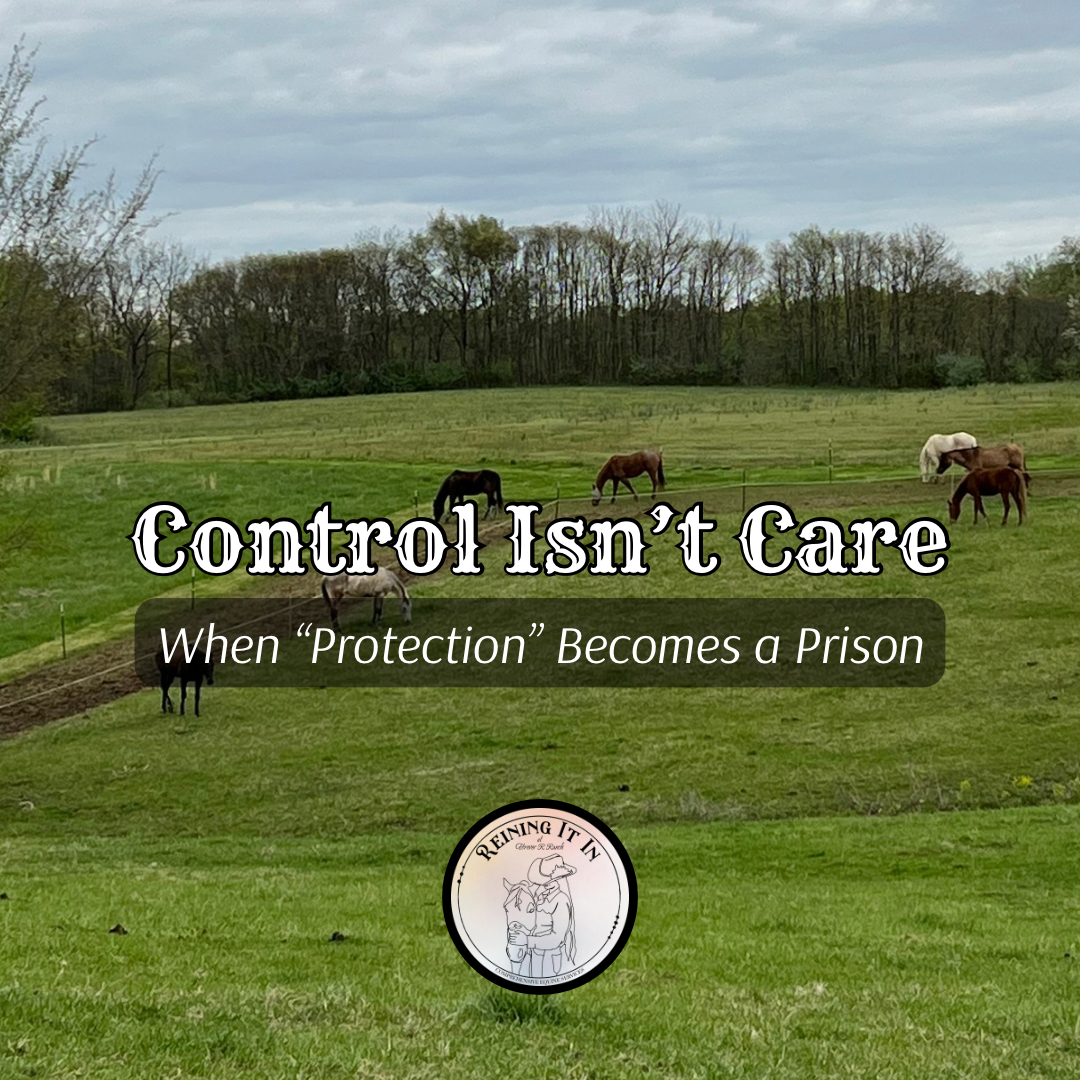
Were You Taught…
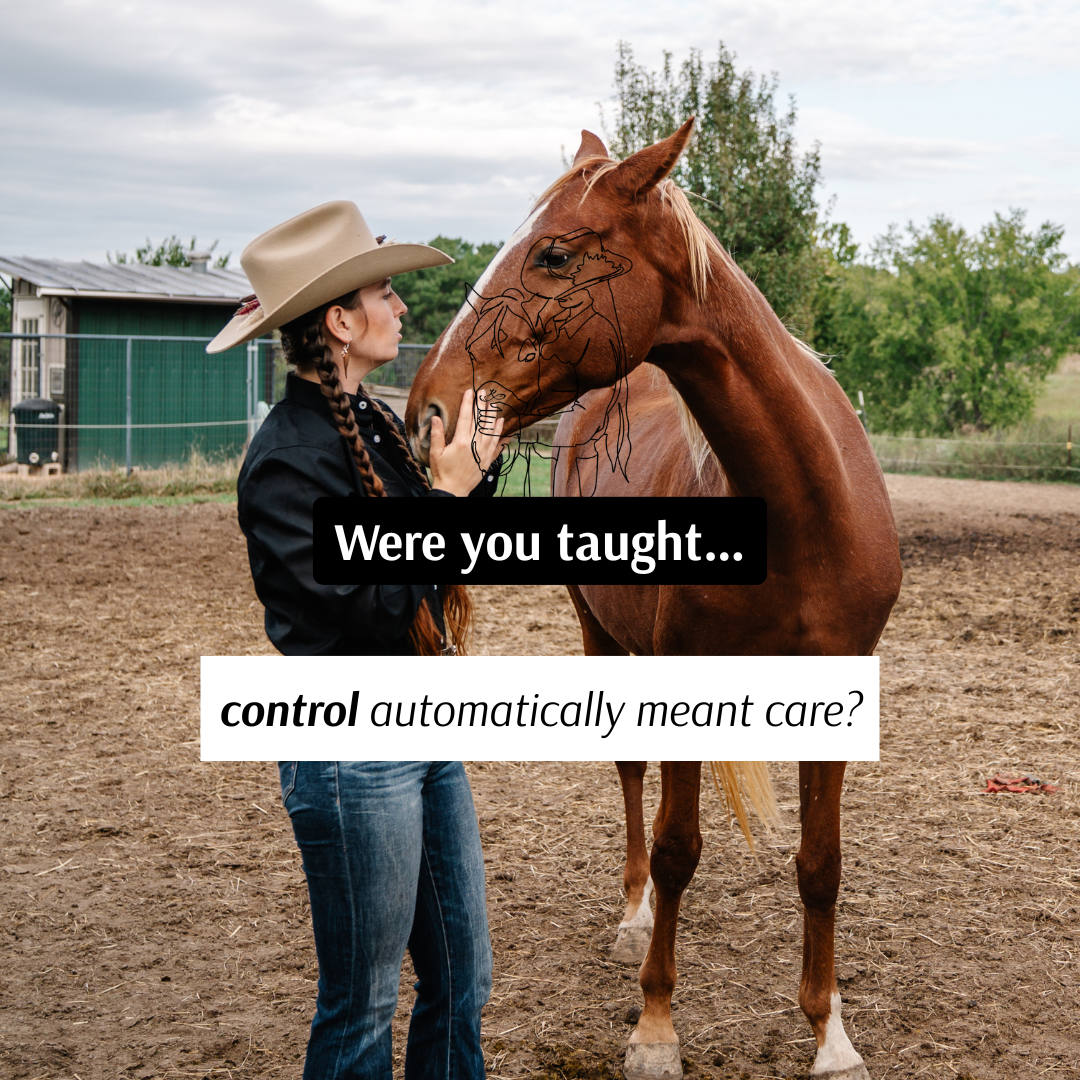
Were you taught by mentors you trusted to look down on others who don’t keep horses in confinement for protection?
Were you taught that good horse care looks like controlling your horse’s every decision?
I was.
It didn’t start that way for me—but it led there.
I learned from people who cared about their horses. People who worked hard. People who wanted to do things “right.” I trusted their experience more than my own questions.
So when something didn’t feel right in my heart, I learned to quiet it.
I learned that structure meant safety.
That restriction meant responsibility.
That control meant love.
And for a long time, I didn’t question it.
Because on the outside, it looked like good care.
Learning Requires Falling
A child learning to walk has to fall a few times to find their balance. Those moments are opportunities for us to learn how to be present when needed—while also stepping back so growth can take place.
Every parent struggles with letting their child find their own way. We want to protect them. We want them to be safe. We are responsible for them.
Yet true safety is not built through constant restriction. It is built through preparation, resilience, and trust.
Human Nature: Control Masquerading as Safety
In nearly every area of life, we seek control. We like predictability, order, and certainty. We often convince ourselves that control equals responsibility.
When this belief takes root, it spreads. It becomes “just the way things are done.” Over time, control is no longer questioned—it is praised.
Why Horses Became Confined
Horses have always held value with us. And what we value, we instinctively try to protect.
It started with stabling hundreds of military and hunting horses in Ancient Egypt. Later, in Europe, stalls were built for high-status horses. Stables became symbols of wealth, readiness, and importance.
Keeping horses standing close, contained, and ready became associated with vitality, prestige, and power.
When Status Becomes “Proper Care”
Today, many are taught—directly or indirectly—that barns represent superior care.
Over time, this belief shaped modern horse culture. Those who offer pasture living are sometimes viewed as careless or uninformed.
But how did we get here? Why did confinement become synonymous with responsibility?
Comparison Culture in Horse Care
Comparisons are dangerous.
We all want our horses protected. Historically, stabling supported survival and status. Today, it supports convenience, predictability, and risk management.
We use stalls to control weather, injury risk, and scheduling. Structure becomes a safety harness. Management becomes “care.” Barn-kept horses have no stake in human survival anymore.
Gradually, horse ownership becomes a competition—who spends more, who controls more, who appears more devoted. “My horses are spoiled!”
The Hidden Cost of Overprotection
Overprotection often leads to overcontrol.
Stalled horses stay cleaner. They are accessible. They are separated from many visible dangers. This gives us predictability. Predictability lowers our anxiety. Fewer pliable accidents feel like good care.
But convenience is not the same as wellbeing. Confinement poses another risk—one we are rarely taught about when convenience is presented as care.
Control feels responsible because it reduces uncertainty—for us. We assume that the absence of injury equals safety. Yet we rarely ask what the horse experiences emotionally and physically.
In efforts to care for and protect the animals we seek partnership in, we’ve effectively built a world around us that prioritizes order and compliance. Obedience becomes easier to measure than wellness. Management replaces relationship.
We trust systems that appear orderly. Horse management is just that. We’ve begun equating management to care rather than caring to manage.
“My horse is expensive. I’d never let him hurt himself in turnout.”
How does an animal designed to live outdoors become unsafe simply by being allowed to live as designed?
The Question We Avoid Asking
What does safety actually look like?
If safety is more than avoiding injury, then what is it? What does safety feel like—to the horse?
Preparation, Not Isolation
In parenthood, safety looks like prepariation.
We do not shield our children from every challenge. We equip them with wisdom, strength, and discernment. We teach them to choose what is good—not because they are forced, but because they understand.
We cannot achieve this through isolation. We achieve it through guidance and example.
Preparing for Living
Horsemanship mirrors this truth.
Safety is not isolation. It is preparation for living.
Domesticated horses face challenges their wild counterparts do not. They need thoughtful care.
Mandated control for horses is where we’ve gotten ourselves—dictating their every move as if they love every moment of standing alone in a wood box. But we are responsible for them, how could we let them live their life without being told what to do?
Preparation, not confinement, is where true protection begins.
Confinement to a horse is terrifying. A social animal segregated by walls won’t feel safe. Horses feel safe through social connection.
Helplessness in routine to a horse is demoralizing. It keeps them from self governing their health. Horses are designed to self-regulate through movement and choice. Limiting forage variety, movement, and social interaction undermines health.
Stagnation to a horse is detrimental. The inability to move as a locomotion-driven species takes a major toll on their body. Free-choice movement—not forced exercise—supports circulation, digestion, joints, and mental balance.
CWhen confinement, helplessness, and stagnation combine, emotional dysregulation follows. Feedback becomes labeled as disobedience. Compliance replaces communication. We’ve stripped our horses of what they were designed for.
The difference between compliance and well being is leeway.
The Cost of Control
Chronic control affects the nervous system.
Separated from your child? Panic.
Our horses have stress responses when they can’t see or touch their herd mates.
Repeated abuse by a family member? Powerless.
Our horses enter a state of learned helplessness when they are constantly controlled.
Constantly going 90-to-nothing? Burnout.
Our horses shut down, or disassociate, when they are repeatedly forced into undesirable negative situations.
• Separation triggers panic. • Constant restriction creates helplessness. • Repeated pressure leads to shutdown. • Forced participation produces burnout.
Over time, horses either dissociate or resist. Trust erodes. Partnership disappears.
Can you imagine feeling panic, powerless, and burnout all together all the time—its what leads to self harm, or worse.
Now, think about being the horse—at the disposal of man—eventually completely disassociating through mental flight or physically fight the very people that made you feel this way.
How can you trust someone who constantly put you in negative situations? Add in their constant comments about how much you love them even though you can hardly stand what they’ve done to you.
Additionally, the effects on the body long term are less than desirable: joint injections, chronic pain and stiffness, weakness, laminitis, obesity, gut issues, lethargy—the list goes on.
This is what happens when living beings are treated as possessions.
Compliance is not success. Wellness invites cooperation and connection.
Care Beyond Convenience
Scripture calls us to righteous stewardship:
“What is the price of two sparrows—one copper coin? But not a single sparrow can fall to the ground without your Father knowing it.” —Matthew 10:29
God cares for the animals through giving them everything they need—as in the Garden with Adam and Eve. They thrive on the world created for them—just as we do.
Domestication has become taking them from that world and giving them man-governed care. Stewardship takes heed of what’s been given rather than create something else.
“The godly care for their animals,
but the wicked are always cruel.” —Proverbs 12:10
Cruelty is not only violence. It is deprivation. It is domination. It is disregard.
Compassion is kindness. It’s provision. It’s dignity. It’s moral.
True stewardship listens. It observes. It adjusts. It considers the animal’s experience—not only human convenience.
What is convenient for us may not be beneficial for our horses. The trouble we go through to provide welfare can reflect curiosity and understanding.
From Control to Connection
We like control because it supports our preferences. But our preferences are not always aligned with our horse’s needs.
Connection offers a better way.
We can provide regular turnout. Initial exuberance is normal. It fades when freedom becomes reliable.
We can create enriched environments: varied hay stations, herbs, terrain, and water placement that encourage natural movement and choice.
Compassion does not mean permissiveness. Boundaries still matter.
Mindful training builds understanding through calm repetition and respect—not fear, flooding, or force. Trust grows through consistency and patience.
Choosing Stewardship
Management, convenience, and compliance belong to possessions. Horses are living, divine creations. They deserve care rooted in movement, autonomy, connection, and nature.
Looking down on those who offer choice and pasture life gains us nothing. Control’s illusion of care does not fulfill our responsibility.
Ask yourself: • What is my true goal for my horse? • Am I acting from fear—or from understanding? • Am I considering their perspective as well as my own?
We can make small, faithful changes that better support innate needs.
Stewardship is quieter. Wiser. Often harder at first. But it leads to deeper trust and truer partnership.
If going against tradition were easy, everyone would do it.
Let us return to the roots of care—mindful horsemanship.
Part 2 of 7